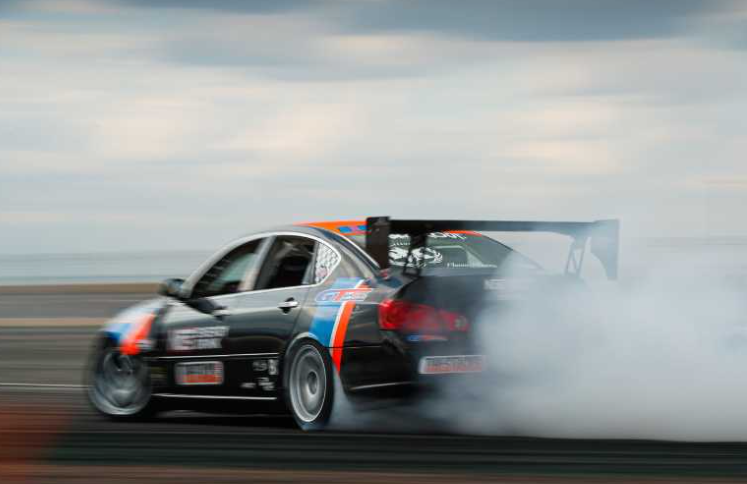
The car slides sideways through a rain-slicked alley, missing a concrete pillar by what looks like inches. The driver holds the line. The camera catches every angle. To the audience, it reads as barely controlled chaos.
What most people don’t see is the three weeks of preparation before those few seconds of footage: engineers, chassis fabricators, and stunt coordinators who essentially rebuilt that car from the ground up. The factory interior came out. A custom roll cage went in. The suspension geometry was redesigned. Every pivot point, every linkage chosen for one purpose—to give the driver repeatable, predictable control under conditions that would push a standard vehicle well past its design limits.
That’s the engineering that makes film stunts possible. Not wire rigs or post-production cleanup—the mechanical precision of the vehicle itself. For every chase sequence where a car holds its line through a corner, or survives a jump landing and keeps moving in a controlled direction, there’s a team of engineers who made that capability repeatable, take after take.
The Stunt Vehicle Is Not the Car You See
The car on screen is rarely the car it looks like. For major action films, a single hero vehicle might have five to ten mechanical stunt duplicates—each stripped to the shell and rebuilt according to what that specific car is expected to do.
The interior goes first. In its place: a roll cage fabricated from chromoly steel tubing, welded to the vehicle’s primary chassis points and designed to hold a survival space around the driver through an inversion. Motorsport racing seats with five or six-point harnesses replace standard seating. A fire suppression system gets plumbed through the engine bay and cockpit. A fuel cell—a bladder-style tank built to resist rupture on impact—replaces the stock fuel tank.
None of this appears on screen. All of it determines whether a stunt ends safely.
The roll cage work for major productions follows motorsport structural standards, but stunt-specific builds go further. When AGI Roll Cages was commissioned to fabricate over 100 bespoke Roll Over Protection Structures for Mad Max: Fury Road starting in 2009, each cage was designed individually for its vehicle and its specific stunt. Some carried mounted camera cranes. Others were built for nitrogen cannon roll sequences. After twelve months of filming under demanding conditions, every person inside those cages came through without serious injury.
That result reflects engineering discipline, not luck.
Engines are often standardized across stunt fleets too. American productions frequently reach for the Chevrolet LS V8—not for any unique performance advantage, but because parts are widely available and every mechanic on set can service it. When a sequence needs thirty near-identical takes, reliability matters as much as power.
Suspension: The Foundation of Controlled Behavior
If the roll cage protects the driver, the suspension is what gives the driver control. For stunt work, control is the whole point.
Factory suspension is calibrated for a balance of comfort, handling, and durability in normal driving. Stunt vehicles work entirely outside those conditions. The suspension needs to handle jumps compressed to full travel, hard braking from speed, sudden high-load direction changes, and deliberate lateral loading during choreographed slides—sometimes within the same sequence.
The common solution is a move to fully adjustable motorsport coilovers. Remote-reservoir units from manufacturers like King Shocks, with separately tunable compression and rebound damping, appear consistently in professional stunt builds. The stunt team can set damping to match the specific surface, load characteristics, and sequence type—rather than working around a factory setup optimized for road comfort.
Beyond the shocks themselves, suspension geometry—control arm lengths, camber curves, caster angles—gets carefully adjusted or fully redesigned for the application. Geometry determines how the tire behaves at its contact patch through a range of suspension travel. Get it wrong and the vehicle becomes progressively less predictable as the suspension works. For a stunt driver executing a choreographed sequence, that unpredictability isn’t just a handling problem—it’s a safety problem.
Weight distribution matters here too. Stunt vehicles are frequently ballasted to shift the center of mass to a specific point, tuned for the maneuver type they’ll be performing. A car set up for sustained controlled slides is weighted differently from one built for precision straightline runs or vehicle-to-vehicle transfers. Braking systems get equal attention—hydraulic handbrakes capable of locking the rear wheels independently of the foot pedal are standard equipment for any vehicle designed to initiate controlled slides, while dual-caliper setups on the rear axle give the driver precise, adjustable brake bias.
Radius Rods: Holding the Geometry Under Load
Within the suspension system, some components do essential work that almost never comes up in behind-the-scenes coverage. Radius rods are one of them.
A radius rod—also called a radius arm or traction bar—is a longitudinal suspension link connecting the axle or wheel carrier to the vehicle chassis. Its job is straightforward: control wheel motion in the fore-and-aft direction. Mounted ahead of the wheel, it resists forward axle movement under braking and prevents wheel hop under hard acceleration. The anti-dive and anti-squat characteristics are built into the suspension geometry by design; the radius rod’s role is to hold that geometry rigidly in place when real loads hit it.
In standard production cars, radius rods are typically stamped steel—adequate for normal road use. In stunt vehicles, which apply sudden, high loads during hard launches, jump landings, and emergency stops, standard-grade components become a variable rather than a constant. The forces generated during a stunt sequence can easily exceed what factory suspension was designed to handle.
Professional builders address this with heavy-duty radius rods machined from solid billet 7075-T6 aluminum or 4130/4340 chromoly steel. The billet construction is the critical part. Unlike welded tube construction, a solid-machined rod has uninterrupted grain flow throughout its length and eliminates the Heat Affected Zones (HAZ) created by welding—both of which are common crack initiation sites under repeated high-stress loading. A stamped or tube-based component may survive the peak load but degrade in fatigue resistance across a shooting schedule measured in weeks.
Here’s what happens during a hard braking event at speed. Weight transfers forward, loading the front suspension heavily and unloading the rear. If the radius rods controlling the rear axle flex or shift under that longitudinal force, the rear suspension geometry moves in a direction the driver didn’t account for. On a public road at normal speeds, this shows up as a handling quirk. In a precision stunt sequence with choreographed timing and other vehicles nearby, it’s a safety issue.
The same logic applies during hard acceleration out of a jump landing, when the drivetrain is pushing power through the suspension while the chassis is still managing the impact. Wheel hop under those combined loads can break traction in ways no amount of driver input fully corrects. A radius rod that holds its geometry eliminates that variable. One that flexes introduces it.
The spec sheet matters in stunt vehicle preparation. The material and construction method of a suspension link determine how the vehicle actually behaves at the limit—not how it’s designed to behave.
Rod Ends: Precision Pivot Points That Don’t Drift
Every adjustable suspension link in a stunt vehicle terminates in a connection that has to do two things at once: transmit loads accurately and maintain geometry, while staying flexible enough to allow the suspension to articulate through its full travel without binding.
The component that handles this is the rod end—a spherical bearing in a threaded shaft assembly, commonly called a Heim joint.
A rod end has a ball swivel that rotates in multiple directions within its housing. This allows the link to transmit axial loads precisely while accommodating the angular changes that happen as the suspension moves. In practical terms: engineers set suspension geometry exactly where they want it, and the rod end lets the suspension follow that geometry through its travel rather than fight it.
For stunt vehicles, rod end quality has a direct effect on vehicle behavior—not just immediately, but over the course of a production. A standard carbon steel rod end works fine in many applications. But a vehicle repeatedly cycled through jump sequences, hard cornering, and controlled overloading will wear standard-grade components faster than the shooting schedule can accommodate.
Professional-grade rod ends for high-demand applications use stainless steel housings. Grade 17-4PH precipitation-hardened stainless—heat-treated to the H900 or H1025 condition—achieves tensile strength around 1310 MPa while handling the corrosion exposure that comes with outdoor or wet-weather shooting. The ball is typically 440C stainless steel—hard enough to resist deformation under sustained high load. PTFE-lined versions cut internal friction and don’t need periodic greasing, which matters when maintenance windows between sequences are short.
Sourcing high-tensile stainless steel rod ends built for sustained high-load applications reduces a real variable in suspension setups where predictability isn’t optional. Wear introduces play into the suspension geometry—sometimes just fractions of a millimeter, but enough to change how the vehicle responds at its limit.
The System, Not the Part
What makes a stunt vehicle stable isn’t a single component—it’s the system.
- Roll cage: protects the driver, contributes nothing to dynamics
- Coilover shocks: control load absorption and recovery speed
- Suspension geometry: determines tire behavior through the full range of motion
- Radius rods: prevent geometry change under longitudinal loads
- Rod ends: allow articulation while holding precision under stress
Remove any one element and the system degrades. The engineering works because every part of it does.
A well-built roll cage in a vehicle with worn rod ends gives you structural protection and unpredictable handling. Perfect suspension geometry in a vehicle with undersized radius rods will lose that geometry the first time hard braking applies real longitudinal force to the axle.
This is why engineers working on professional stunt vehicles specify every component in the system. Chassis fabricators, suspension tuners, and stunt coordinators work together to make sure the vehicle’s mechanical behavior matches what the sequence requires. The director sees a car sliding around a corner within inches of its choreographed path. The build team made the vehicle capable of doing exactly that—not approximately, not close enough.
Conclusion
Film action sequences are an exercise in controlled deception. The violence looks improvised. The engineering underneath it is exacting.
The precision slide that holds the screen for four seconds was possible because someone specified the right rod end for the load, calculated the radius rod geometry for the expected forces, and tuned the coilover damping to match the surface. The director saw a car moving exactly where it was supposed to move. What they were actually watching was the output of a suspension system that someone spent days calibrating.
For anyone who starts noticing the engineering side of these sequences: the vehicles are rebuilt, not modified. The suspension is tuned, not standard. The pivot points are precision components, not stock parts. And the result—a driver holding a vehicle at its limit inside a choreographed sequence, take after take—reflects that directly.
The fabricator who welded the cage, the engineer who specified billet radius rods, the supplier who provided rod ends built to aerospace material standards—their names don’t appear above the title. But the sequence they made mechanically possible does.
That’s the engineering behind cinema. By design, most of it stays invisible.